18-Aug-2026
Jurat vs Acknowledgment in a Loan Signing
The Jurat and the Truth
When you sign under a jurat, you affirm under oath that the statements in the document are true to the best of your knowledge. The notary must witness your signature and administer a verbal oath or affirmation, making this a sworn declaration. A loan application containing financial disclosures often requires a jurat to deter misrepresentation. Your spoken response to the notary’s oath binds the act with legal weight, turning the moment into a formal attestation recognized in court.
GET THE NOTARY FIELD GUIDE, CHECKLIST & CHEAT SHEETS
The Acknowledgment of the Will
When you sign a will, the acknowledgment confirms you willingly made the document and understand its contents. Unlike a jurat, this act doesn’t require you to swear under oath about the truth of the statements within. Instead, you declare in the notary’s presence that the signature is yours and that you are of sound mind. A mid-sized SaaS firm updating its executive estate planning might use this step to formalize directives without requiring testimony on each clause. The notary then certifies your identity and the validity of your declaration, completing the legal formality.

The Notary and the Choice
As the signer, you face a key decision when the notary arrives: whether to sign under jurat or acknowledgment. This choice depends on the document’s purpose and the signer’s intent. A jurat requires you to swear or affirm the truth of the content before signing, while an acknowledgment confirms only that you signed willingly, not the truth of the statements. Loan documents often use acknowledgments, but certain affidavits or sworn statements demand a jurat. The notary will guide you based on the form’s wording and state requirements, ensuring the act matches the legal standard. Your role is to understand the difference and respond accurately to the notary’s prompts.
The Physical Act at the Table
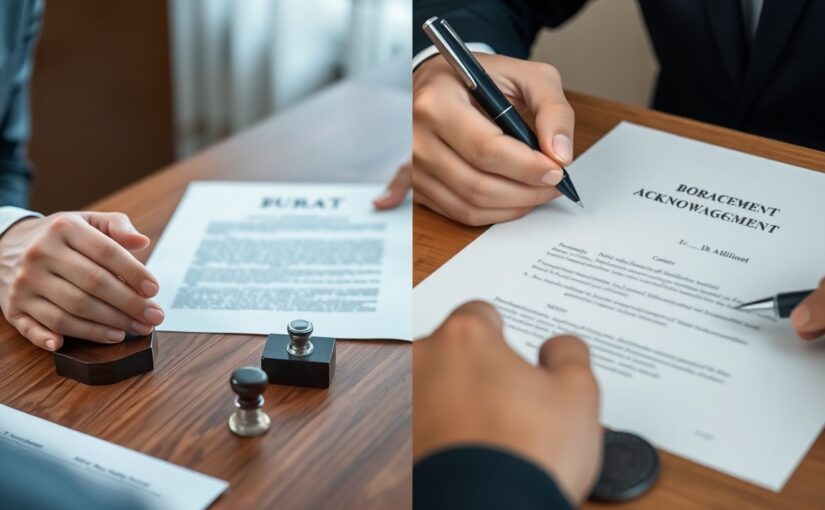
You sit across from the notary, documents laid out with the lender’s instructions followed precisely. For a jurat, you speak the oath aloud, affirming under penalty of perjury that the statements in the document are true, then sign while the notary watches. With an acknowledgment, you declare you signed willingly, but no oath is given, and the notary verifies your identity and intent. A mid-sized SaaS firm refinancing its equipment lease recently completed both acts in a single appointment, each requiring distinct verbal declarations at the table.
The Paper and the Pen
You hold the pen above the document, your hand steady, aware that this single motion carries legal weight. The paper before you is not just a contract but a formal record, its lines and margins structured to meet statutory standards. Your signature, placed exactly where indicated, becomes binding only when made under the correct notarial act-whether sworn to on a jurat or affirmed through an acknowledgment. A misplaced pen stroke, an incorrect notarial certificate attached, or a failure to sign in the notary’s presence can invalidate the entire execution. Notaries routinely reject documents when the pen moves too soon, before oaths are administered or identities confirmed. In one documented case, a loan package was delayed for seven days because the borrower signed the promissory note before the notary arrived, mistaking the acknowledgment for a simple formality. The physical act of signing, governed by precise rules, separates valid execution from procedural failure. Every pen used must create indelible marks, every page presented in sequence, every initial applied with intent. This is not mere paperwork-it is the material evidence of consent, witnessed and preserved. A mid-sized SaaS firm automating loan closings learned this when their digital pen system failed to timestamp wet-ink signatures, leading to three refinance deals being challenged in escrow. The tool matters, but so does the timing, the form, and the adherence to the notary’s oversight. Your signature, when properly executed, becomes more than a scribble-it becomes proof.
Final words
You sign a loan document under a jurat when you must swear to the truth of its contents, such as confirming the accuracy of income details on a mortgage application. An acknowledgment applies when you only need to verify your identity and willingness to sign, common in refinancing agreements. Your notary determines which form applies based on the document’s purpose and state requirements, ensuring the signing meets legal standards. A mid-sized SaaS firm automating loan closings found that correctly distinguishing these two notarial acts reduced processing delays by aligning each signature with the appropriate verification method.
Leave a Reply